Instruments / Polarimeters
This page describes the polarimetric instruments whose data are included in the asteroid observation catalogue.
Dual-channel photoelectric polarimeters POLSHAKH
The POLSHAKH complex consists of two dual-channel photoelectric polarimeters designed for high-precision polarimetric observations of astrophysical objects.
One instrument is installed at the 2.6-m ZTSh telescope of the Crimean Astrophysical Observatory, and the other at the 2-m RCC telescope of the Terskol Peak Observatory.
The instruments are based on a dual-channel detection scheme allowing simultaneous measurements of orthogonal polarization components. This improves measurement stability against atmospheric transparency variations and changing observing conditions.
The polarimeters operate in broadband photometric filters and allow the use of specialized narrowband filters.
Crimean Astrophysical Observatory
2.6-m ZTSh telescope, POLSHAKH configuration for high-precision polarimetric observations.
Terskol Peak Observatory
2-m RCC telescope, POLSHAKH configuration with dedicated optical and spectral capabilities.
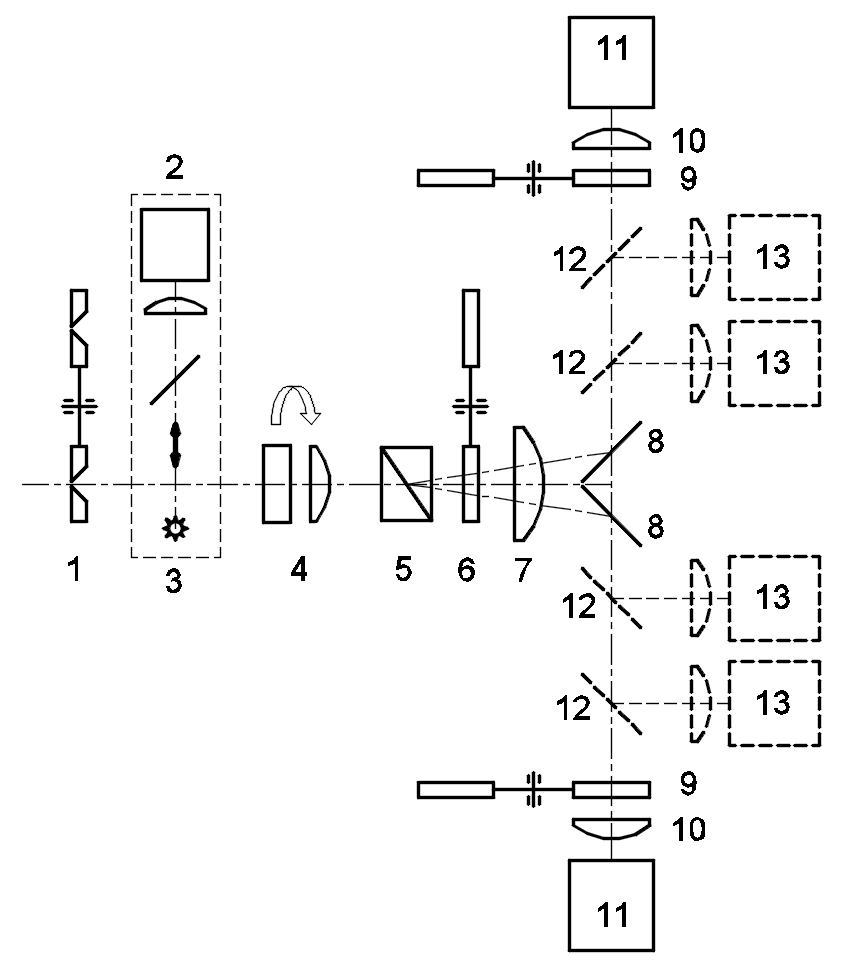
Optical scheme
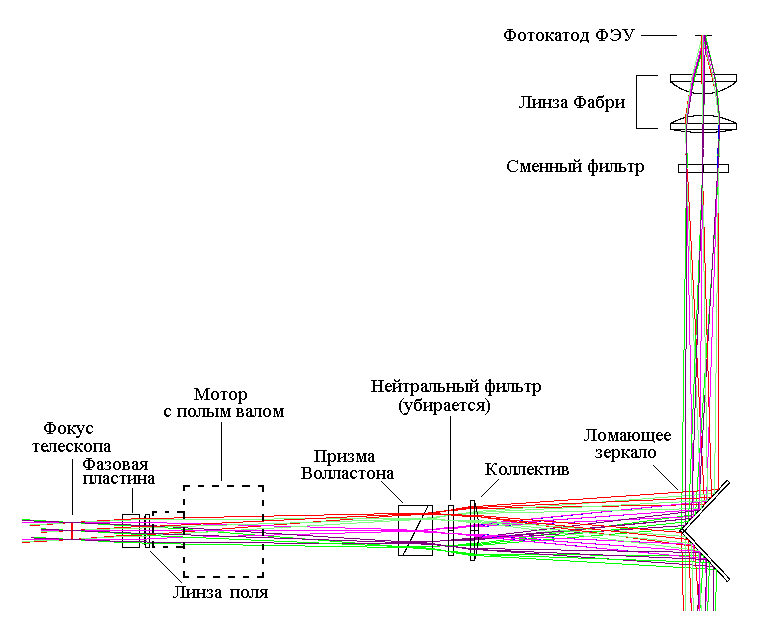
The optical scheme includes phase plates, field and collimating optics, a Wollaston prism, filter units, and independent detection channels. The dual-channel scheme enables simultaneous registration of orthogonally polarized components.
1 — Telescope focus
2 — Field lens
3 — Half-wave phase plate (polarization modulator)
4 — Neutral density filter
5 — Wollaston prism
6 — Collimator
7 — Camera lens
8 — Beam splitter
9 — Interference filters
10 — Fabry lens
11 — Photomultiplier
12 — Fold mirrors
13 — Detector channels
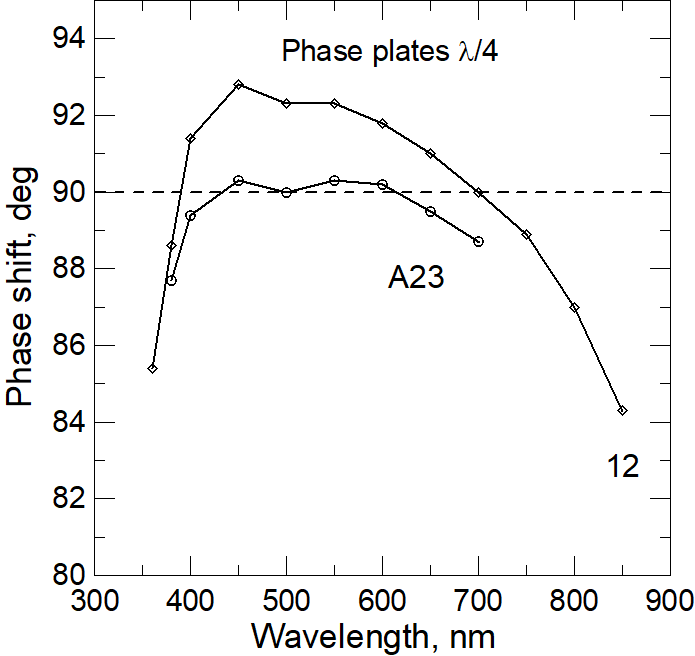
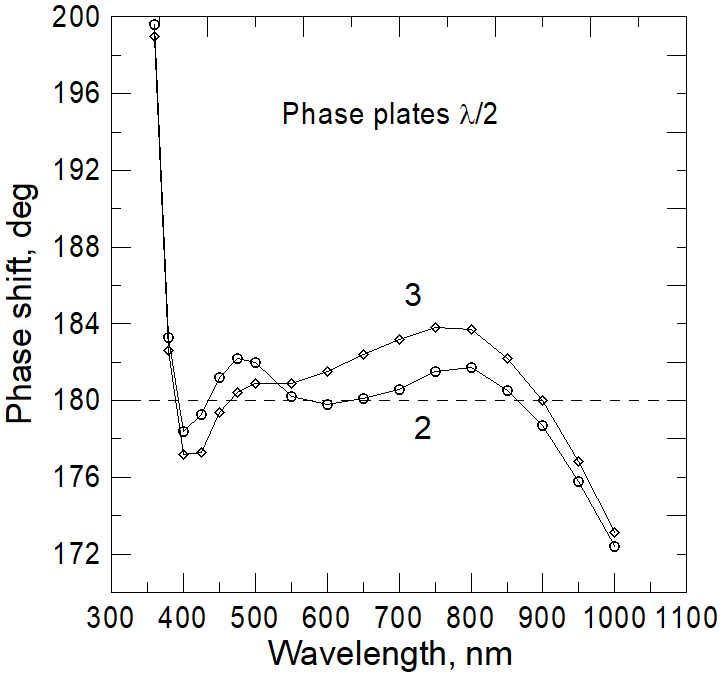
Polarization elements
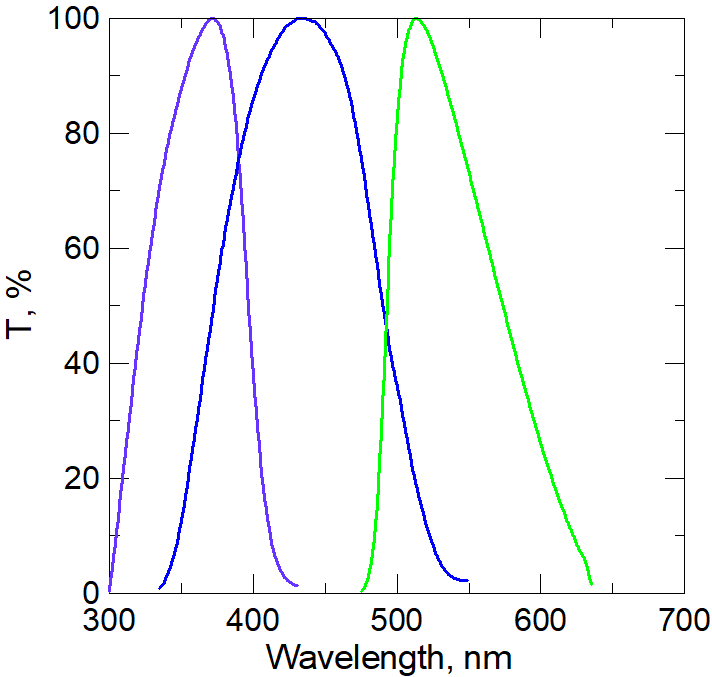
The polarization performance of the instrument is determined by the characteristics of the phase plates. The figures below show the spectral dependences of phase shift for λ/4 and λ/2 plates.
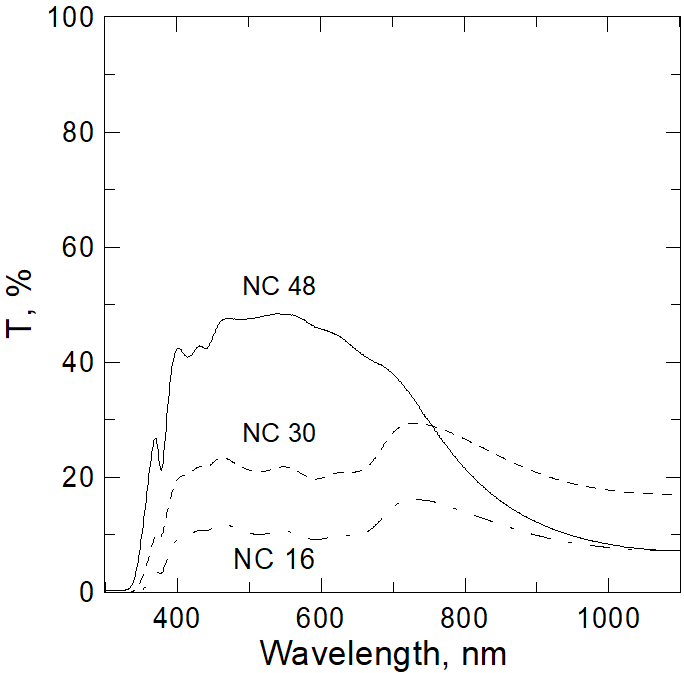
Spectral characteristics
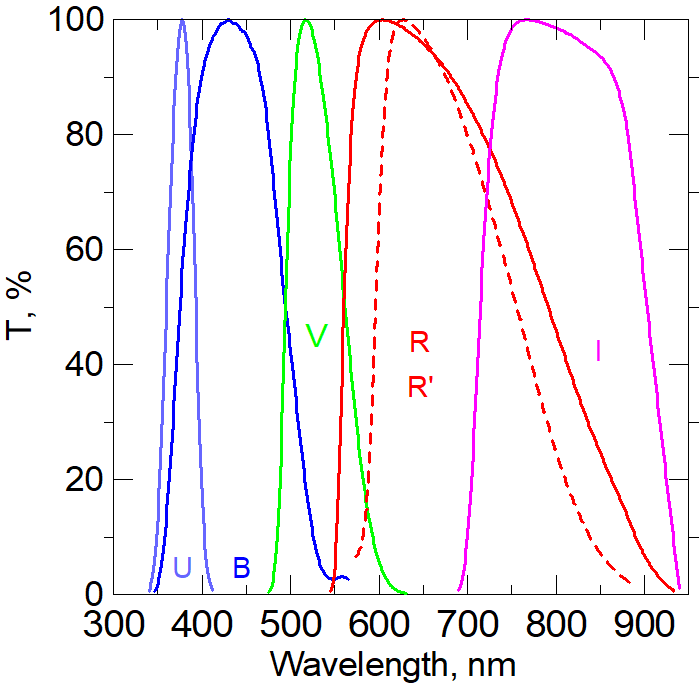
The polarimeters include a set of exchangeable optical elements, including broadband photometric filters and specialized filters. Their transmission curves define the working spectral range and observing modes of the instruments.
Optical path configuration
The optical path includes a phase plate, field lens, Wollaston prism, collimator, filter unit, and photoelectric detectors. The modular layout allows the configuration to be adapted to different observing programmes.
Use of these data in the database
Observations obtained with these instruments are included in the database catalogue.
A significant part of the dataset consists of new polarimetric measurements of near-Earth asteroids obtained at the Crimean Astrophysical Observatory and the Terskol Peak Observatory.
In the observation catalogue, measurements obtained within these observing programmes are highlighted in yellow.
Reference
Shakhovskoy D.N., Kiselev N.N., Dolgopolov A.V., Antonyuk K.A., Ivanov Yu.S., Karpov N.V., Taradiy V.K., Savushkin A.A., Ryabov A.V., Taran A.V.
Dual-channel photoelectric polarimeters (POLSHAKH) of the Crimean Astrophysical Observatory and Terskol Peak Observatory: optical scheme, design, and first observations.
Scientific Works of INASAN, 2024, vol. 9, no. 4, pp. 165–176.
DOI: 10.51194/INASAN.2024.9.4.009